

The Double-Edged Flag: When Filipino Americans Run Against Each Other For the Same Office
We wanted Filipinos in power. We never asked what they’d do with it.
Written by Clifford Temprosa
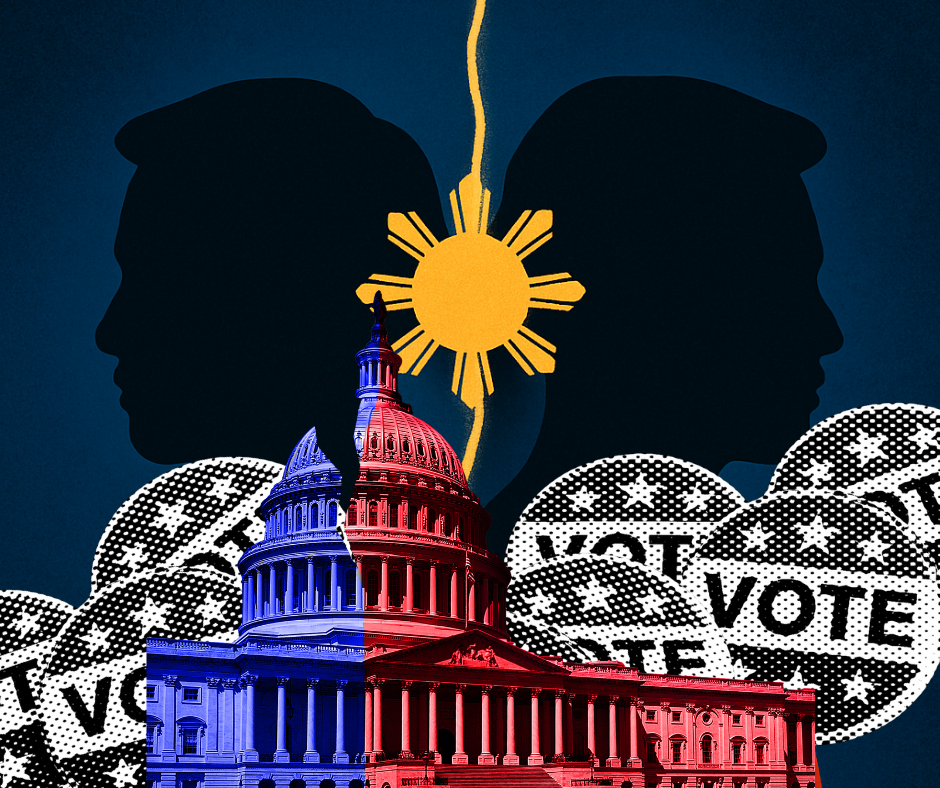
The Paradox of Arrival
For decades, visibility was the dream. Filipino Americans looked at city councils, state legislatures, and Congress and wondered: When will we finally be seen? When will our names, our faces, our accents belong in the political landscape of the country we helped build?
That moment has arrived. Across the United States, Filipino Americans are now mayors, judges, delegates, and policymakers. Our stories, once relegated to the margins, now shape legislation and discourse.
But visibility has brought with it an uncomfortable mirror: what happens when representation turns inward - when we begin running against each other?
In California, Hawaii, New York, and Nevada, Filipino Americans are increasingly finding themselves on opposite sides of campaigns, political parties, and ideologies. The sight of two Filipinos on the same ballot once symbolized unity. Now, it exposes our complexity.
The question is no longer “Do we have a voice?” It’s “What kind of voice have we become?” Because representation without ideology isn’t progress - it’s regression disguised as pride.
The Fragile Politics of Pride
Representation was never meant to be the finish line—it was meant to be the foundation. But somewhere along the way, visibility became validation. We learned to celebrate Filipino faces in office without asking what values guided their votes.
For a community long starved of recognition, this instinct is understandable. To see a Kababayán on the stage of power feels like victory in itself. But identity, without ideology, can become an empty symbol.
Representation can heal, but it can also divide.
Because when two Filipinos run for the same office, the question quickly shifts from “Who do we support?” to “Whose version of being Filipino do we believe in?” Is there a definitive wrong? If we deny one story over the other, are we no better than hypocrites who call out white supremacy?
One may campaign on faith and family, the other on equity and reform. One speaks the language of tradition, the other of transformation. Both claim the flag but their visions for what it means can be worlds apart.
The Spectrum of Belief: Liberals, Conservatives, and the Myth of Political Sameness
There is no single Filipino political identity. We are a people shaped by migration, religion, class, and geography - factors that pull our politics in divergent directions.
Many first-generation immigrants arrived from a deeply Catholic, socially conservative Philippines, carrying values rooted in hierarchy, discipline, and faith. For them, “American politics” often feels like a moral battlefield. They prize order, family, and personal responsibility, suspicious of systems that challenge tradition.
Meanwhile, younger Filipino Americans—born or raised in the U.S.—tend to lean progressive. They’ve grown up witnessing racial injustice, gender inequality, and economic precarity firsthand. Their politics are often shaped by solidarity across communities of color, not by nostalgia for the homeland.
To assume all Filipino immigrants are liberal is as lazy as assuming all young Filipinos are radical. Our political consciousness is as plural as our diaspora. The nurse in Texas, the tech worker in San Jose, and the student organizer in Queens may all call themselves Filipino—but their lived realities produce entirely different visions of justice.
When Filipino Americans run against each other, they don’t just debate policy—they embody these fractures: faith versus freedom, assimilation versus resistance, tradition versus change.
And that’s the hardest truth to face: representation doesn’t always mean solidarity.
The Politics of Gratitude
Many Filipino immigrants equate political conservatism with moral gratitude—a sense that success in America is proof of divine reward, not structural advantage. To question the system that gave you a visa, a paycheck, and a home feels like disloyalty. Gratitude becomes a civic virtue, but also a political leash.
We are taught to keep our heads down in exchange for opportunity—to vote for order, even when order betrays justice.
This quiet obedience masquerades as respect, but it’s really a survival reflex still echoing from colonial classrooms. The politics of gratitude keeps us grateful enough to assimilate, but not courageous enough to transform.
Sacrificing Politics for Representation
In our hunger to be seen, we often mistake identity for progress. We rally behind candidates because they are Filipino, not because their platforms align with the community’s collective needs. We confuse shared heritage with shared interest.
The result is a dangerous moral trade-off: we sacrifice politics for representation.
We tell ourselves, “At least we have a Filipino up there.” But what happens when that Filipino votes against labor rights, immigrants, or reproductive health? What happens when cultural pride blinds us to political consequence?
To support someone simply because they “look like us” is not empowerment—it’s nostalgia masquerading as strategy. Visibility without values is just a flag without a cause.
Colonial Echoes in Campaign Colors
Every election reveals the ghosts of our history. Our political divisions in America often echo the contradictions of the Philippines itself: colonial loyalties, class hierarchies, religious influence, and patronage networks reborn in a new context.
The Filipino conservative who invokes discipline and duty draws from the same moral order once used to maintain colonial obedience. The Filipino progressive who rallies for decolonization sometimes reproduces the same elitism of intellectual exclusion.
Both sides, in their conviction, mirror the nation they left behind—fragmented, passionate, and perpetually arguing over whose patriotism counts.
Filipino American politics is not an extension of either nation—it’s a mirror that exposes the contradictions of both. We brought the Philippines’ class hierarchies into America’s racial hierarchies and built a political culture fluent in both obedience and aspiration. Our votes are bilingual—loyal to opportunity, haunted by history.
The painful truth is that Filipino political identity in the U.S. did not start here. It migrated with us—complete with its old hierarchies, its aspirations, and its unfinished revolutions.
The Ethics of Intra-Community Conflict
When Filipino Americans run against each other, we are forced to confront a moral dilemma: Does representation demand loyalty, or does democracy demand choice?
Too often, community organizations and voters are pressured to pick sides not based on policy, but on pakikisama—the cultural expectation of harmony. To question one’s own becomes taboo. But politics requires friction. Progress requires disagreement.
If our first generation fought to be represented, the next must learn how to disagree without disowning each other.
Because solidarity built only on sameness is fragile. And loyalty without accountability is dangerous.
The Question of Loyalty: Who Do We Owe Our Voice To?
For many Filipino Americans, politics is not just about platforms — it’s about belonging. To criticize the Philippine government risks being branded “un-Filipino.” To critique American systems of racism risks being told to “be grateful.” So we oscillate between two flags, afraid of betraying either.
But what if loyalty isn’t about silence — what if it’s about honesty? True patriotism may mean telling both nations the truths they don’t want to hear.
Who do we really serve when we stay quiet? The homeland that left us, or the one that keeps us useful?
Generations and Geography: How Migration Shapes Mindset
The Filipino in Daly City is not the same as the Filipino in Houston or Honolulu. Each community’s politics reflect the conditions that built it: the industries that hired them, the churches that sustained them, the neighborhoods that welcomed or rejected them.
Migration is not a neutral story—it is a political education. Filipinos who arrived as nurses or professionals during the 1980s Reagan era absorbed American conservatism alongside opportunity. Those who came as refugees or under student visas in the 2000s grew up in an age of activism and identity politics. Children of both inherit a hybrid politics: faith from their parents, dissent from their peers.
This diversity is not division—it’s the raw material of democracy. But only if we are willing to name it, study it, and stop pretending it doesn’t exist.
The Divide of Faith and Freedom
The Church built much of the Filipino moral compass — both in Manila and the Midwest. It shaped our compassion, discipline, and devotion. But it also hardened our politics, turning religion into regulation.
In America, Filipino conservatives invoke faith as moral order; progressives invoke justice as moral duty. Both cite God but their gods demand different policies.
In every election, sermons turn into campaign speeches, and pulpits into platforms. Perhaps the real question is no longer whether faith belongs in politics, but whose version of faith gets to define morality and who gets left outside its grace.
The Silence of Success
Immigrant success stories are the crown jewels of diaspora pride — nurses who built houses for their families, engineers who sent siblings to college, parents who “made it.” But success can be its own silencer.
Comfort makes critique costly. Those who escaped poverty often avoid politics — afraid that agitation might disrupt stability. We call it “peace,” but maybe it’s political anesthesia.
The question we rarely ask: What happens to a movement when its most successful stop showing up?
The Left, the Right, and the Myth of the Middle
Filipino Americans often describe themselves as “moderate” — weary of division, proud of balance. But neutrality is a luxury of safety.
There is no middle ground in moral crisis — only comfort or courage. Those who claim to “stay out of politics” are not apolitical; they are insulated.
To be neutral in the face of inequality is to preserve the order that benefits us. When we say we are in the middle, what are we standing on? Principle, or privilege?
The Myth of the “Good Filipino Politician”
We love to anoint heroes. We crave the Filipino politician who will finally “represent us right.” But such purity is a myth. No one person can carry the totality of a people - especially a people as complex as ours.
We forget that representation is not a mirror - it’s a responsibility. To expect a single Filipino leader to embody an entire diaspora is to recreate the same pedestal that power always betrays.
Real representation begins not with charisma, but with community literacy - with voters who understand not just who they’re voting for, but what systems their votes sustain.
From Symbol to Substance
If we want Filipino American politics to mature, we must evolve from celebrating faces to interrogating frameworks. We must ask:
● What policies do these candidates champion?
● Whose interests do they serve?
● Who funds their campaigns—and who remains invisible in their speeches?
Visibility is never free. Campaign donations from real estate developers, lobbying firms, and ethnic power brokers shape what Filipino candidates can say long before they take office. The illusion of independence is often bankrolled by interests that see “Filipino representation” as convenient branding, not political liberation. When power becomes a performance for donors rather than a platform for the people, representation mutates into marketing.
Because representation without redistribution is just visibility wearing a suit. And pride without policy is only performance.
Our parents believed in the American Dream — that discipline, hard work, and humility would earn them safety. And for many, it did. But for their children, the dream feels like a ceiling, not a ladder.
Younger Filipino Americans have seen how race and wealth define who gets to “make it.” They are no longer chasing inclusion; they are demanding transformation. Their politics are not just about fitting in. They are about reimagining the system entirely.
Maybe the divide is not between generations, but between those who want to belong and those who want to rebuild.
Our politics cannot stop at the surface of ethnicity. Otherwise, we risk turning representation into another colonial mirror. One that flatters us without freeing us.
The New Responsibility of Representation
The rise of Filipino American leaders should not end with celebration. It should begin with civic education. Communities must invest in political literacy, voter training, and ideological dialogue. We need spaces where our people can debate—not destroy—each other.
Our power as a diaspora lies not in uniformity, but in our ability to hold contradictions with compassion. We can vote differently and still build together. We can argue fiercely and still march side by side for justice.
We must stop pretending that neutrality is noble. Silence is not balance - it is bias in camouflage. Filipino Americans cannot call for unity while refusing to name what divides us. Justice requires judgment. The challenge is not to pick a side, but to pick a principle.
Solidarity does not mean sameness. It means accountability to shared principles, not shared ancestry.
Because the flag we raise in politics should represent more than origin. It should represent obligation.
The Call to Rethink the Flag
Representation was never the goal. Liberation was. If Filipino Americans want to honor that legacy, we must move beyond the symbolism of presence and into the substance of purpose.
The next era of Filipino American politics will not be defined by how many of us hold office, but by what we do once we’re there, and whether we can hold each other accountable when we don’t.
Representation is only the beginning, not the destination. We celebrate our politicians, but the truest test of democracy happens between elections — in community halls, advocacy networks, mutual aid groups, and kitchen table debates.
The ballot box is not the birthplace of change; it’s merely its receipt. The question is whether Filipino Americans can turn symbolic wins into structural ones.
Will we settle for seeing our names on ballots or will we build the systems that make those votes matter?
The double-edged flag reminds us that representation is not salvation. It can wound as much as it can heal. The next generation of Filipino American politics will be judged not by how many of us hold office, but by how many of us dare to hold each other accountable. Pride built on silence is just colonialism in costume. The flag will mean nothing until we learn that power, too, must be decolonized.
Because in the end, it’s not about who gets to wave the flag. It’s about who carries its weight. Because in the end, every Filipino who enters power abroad also inherits the unfinished revolution of the one they left behind.
Written by Clifford Temprosa
















Maybe it’s time to stop defining who we are by what we’ve suffered, and start loving who we’ve become.
Read More